I've got an ornamental windmill in the front yard which spins about 50% of the time, although it spins freely whereas a power generating windmill has a lot more load on it. Our next door neighbours have a power generating windmill which doesn't seem to spin very often at all. It has blades which look to be about 1.2 metres long and is mounted on a post approx 7 metres tall.
Ironically, some working farms around here with windmills (which pump up water for stock) have recently been replacing them with solar powered pumps.
Aging into the night said
09:23 PM Feb 1, 2026
I don't have an issue with solar, as I've mentioned previously, we have photovoltaics on our roof and a micro hydro system which both power our house. I also have a solar water pump (Commodore, Shepparton) which pumps water to our tanks and dam. which is switched off at the moment due to the creek drying up. The micro hydro is also turned off for obvious reasons, no water but plenty of sun, so the lithium batteries are happy.
so our power system has built in redundancies. Which is what I'm trying to achieve with the power system in our camper trailer, we have solar to charge the two lithium batteries, but I'm after something additional to solar to keep the batteries happy. Hence my query about wind turbines.
Peter_n_Margaret said
10:56 PM Feb 1, 2026
As a back-up you won't beat this....a genuinely quiet generator. https://www.efoy.com/ We had one of these when we toured Europe in a motorhome for 3 years some years back. Made about the same noise as a compressor fridge, can be used inside the motorhome, a little CO2 and some pure water are the only waste products and will run 24/7.
-- Edited by Peter_n_Margaret on Monday 2nd of February 2026 09:12:38 AM
Ineedabiggerboat said
10:53 AM Feb 2, 2026
Consider weight. Fuel availability. Service network.
Gundog said
07:32 PM Feb 2, 2026
I ditched alll my solar panels save one, and 2 batteries replaced them with 3.5 Noisy Generator.we
As soon as I start the generator I dont need to conserve power we can run whatever we want.
Stevejaz said
08:15 PM Feb 2, 2026
Just a point on generators. When used to charge batteries they are only as good as your mains charger. We use a 2.2 Honda (when we need to and generally a maximum of a couple of hours.) We have 2x30amp Victron chargers (one in motorhome one in A Van). We have 2x20amp Redarc BC-DC chargers and in my opinion a 3 Ltr diesel is not really going to make less noise for what amounts to less charge in batteries. I prefer to use the appropriate tool for the job. The Chargers put about an 800Watt load on the generator which is a reasonable load @ under half capacity. Noise does depend on load.
As one living on a "Kings" budget, I can totally recommend their 360Watt solar blanket(s) I have one and since upgrading the A Van to Lithium, the Redarc now disconnected, I will probably buy a second. They DO give a pretty good 360 Watts and a pair out in the midday sun give way more power than the 30amp mains charger powered by the generator. There are always going to be times of no sun though and I would NOT be without the generator.
It is purely for use as and when needed though rather than a main source of power.
I am finding the 250Watt panel on A Van roof plenty to keep batteries charged in A Van while driving and will not bother with a DC-DC charger until I double the battery size. 120 ah to 24ah.
landy said
10:10 PM Feb 2, 2026
Gundog wrote:
I ditched alll my solar panels save one, and 2 batteries replaced them with 3.5 Noisy Generator.we
As soon as I start the generator I dont need to conserve power we can run whatever we want.
-- Edited by landy on Monday 2nd of February 2026 10:24:42 PM
-- Edited by landy on Monday 2nd of February 2026 10:25:15 PM
Aging into the night said
10:51 PM Feb 2, 2026
Peter ,I like the idea of that quiet generator. I'll probably increase the solar array wattage as well. Our WAECO fridge/freezer uses a lot of power, the lights not so much.
I'll take a closer look at that generator tomorrow, off to punch out a few zzzzs now.
Cheers
Brendan
Peter_n_Margaret said
08:47 AM Feb 3, 2026
You can not have too much solar, and the more solar that you have the less battery capacity that you need because the battery only needs to supply the energy for the night.
Cheers,
Peter
Peter_n_Margaret said
03:00 PM Feb 3, 2026
Lots of solar............... June 2024 in WA.
It is raining. 5A is enough to run the compressor fridge and the compressor deep freeze.
Rain stopped but still 100% shade from the clouds.
Cloud breaking up and light reflects from the nearby clouds.
Add more solar and you can be happy when others are not.
There is 1160W of solar. The PL60 controller is a 20+ year old PWM.
Cheers,
Peter
-- Edited by Peter_n_Margaret on Tuesday 3rd of February 2026 03:03:28 PM
Today in Nth Qld os a typical wet season it started heavy rain around 4am to about 7ish where it became regular showers, then around 10am it turned into a tropical storm realy pouring down with a bit of thunder and lightning, visability approx 100m, this eased off around 11 and the constant heavy showers 15-29 minutes all afternoon, its now 7pm with no relief in sight. In between the rain the sky has been leaden grey.
How do your solar system stand up to those conditions.
DMaxer said
08:27 PM Feb 5, 2026
I dont run much off my 120 Amp battery and one 250 solar panel, just computer and a separate modem, water pump and lights plus some phone charging and the 12 volt fan and idiot box but I can last at least three days of rain and cloud with the battery staying above 12 volts.
A wet day or two means nothing.
jacks said
10:53 PM Feb 5, 2026
Peter_n_Margaret wrote:
jacks wrote:
Peter, in what way are your 1160W of solar hooked up for the 60 amp controller to not be overloaded?
If the solar harvest exceeds 60A, the controller sheds the excess to protect itself (as many good quality controllers do).
Alternatively, I can switch some panels off if required.
Cheers,
Peter
Thanks Peter.
Peter_n_Margaret said
10:15 AM Feb 6, 2026
Gundog wrote:
Today in Nth Qld os a typical wet season it started heavy rain around 4am to about 7ish where it became regular showers, then around 10am it turned into a tropical storm realy pouring down with a bit of thunder and lightning, visability approx 100m, this eased off around 11 and the constant heavy showers 15-29 minutes all afternoon, its now 7pm with no relief in sight. In between the rain the sky has been leaden grey.
How do your solar system stand up to those conditions.
Your biases are showing Gundog.
Unless you are riding a bicycle, almost every RV has an alternator fitted to the engine. It is designed specifically to charge batteries and makes a very effective and cheap back-up electrical energy supply on the rare occasions that plenty of solar does not supply what you need.
How you organise that to happen is a choice that you can make. You could use a set of jumper leads or a DC-DC charger or a permanent direct connection, as I do.
Any time the OKA engine is running, I can charge the (lithium, and before them the AGM) house batteries directly from the alternator whether driving or stationary.
Cheers,
Peter
Ineedabiggerboat said
03:05 PM Feb 6, 2026
Some areas of Scotland have not had ANY sun for 15 days and some areas have not had a day without rain this year.
Weather is fickle.
Peter_n_Margaret said
04:18 PM Feb 6, 2026
Ineedabiggerboat wrote:
Some areas of Scotland have not had ANY sun for 15 days and some areas have not had a day without rain this year. Weather is fickle.
Anywhere can have bad weather. If the forecast is for a week, or more, we go somewhere else. That is the beauty of having wheels.
We were once in Kununurra and it was 38C and raining. 2 days later we were on the Queensland coast 10C cooler. You do have choices.
And we have motor homed in Scotland. It is a wonderful destination with free camping available in most areas (unlike England) and very friendly people.
We drove 3,200km in 3 1/2 weeks. Cool temperatures make for good solar collection and lower fridge consumption.
You can search as easily as I can, I have no wish to satisfy your problem.
Do you actually imagine a 30 year Australian specialist in these products not complying with Australian regulations?
Cheers,
Peter
PeterInSa said
10:34 PM Feb 6, 2026
Re (That PL60 has been in constant use in our OKA for 21 years now.)
I don't Think a Controller that was installed 21 years ago, needs to be compliant with a Standard AS61.... that was introduced in Oct 22, 2021.
But if it was replaced with a new controller thats another story.
Peter_n_Margaret said
11:05 AM Feb 7, 2026
Yes, regulations change from time to time and Australian manufacturers will change their products appropriately if required, you can be quite sure of that.
You can be less sure that this happens with imported products, particularly if purchased on Ebay and the like.
Cheers,
Peter
Peter_n_Margaret said
04:06 PM Feb 7, 2026
For those interested in direct charging your house battery from the alternator, I just took some pics to show the effect.
The house battery is a 326Ah CALB LiFePO4 with 250A Daly BMS and the crank battery is a FullRiver HC75 cranking AGM, 930CCA.
The alternator is a bog standard 85A Bosch.
This is what I see in the OKA cab.
From the left, LEDs show crank battery voltage, house battery voltage, Amps (green) flowing from the alternator to the house battery.
The switches activate a VSR relay that can be locked closed manually (does not need to be a VSR type relay).
Ignition ON, engine not running.
Engine running, at idle speed, shows alternator output voltage.
Engine running, at idle speed, with relay closed and locked. Shows apparent crank battery and house battery voltages and the Amps of charge going into the house battery. These voltages will both climb to 14.3V as the house battery becomes more charged.
The charge rate into the house batteries will vary with the difference in voltage between the house battery and the alternator. In this example that difference was only 1.5V. If the difference is larger, the charge rate will be greater. As the voltage difference reduces, so will the charge rate. Increasing the engine RPM makes little difference.
This arrangement is very effective. The alternator voltage is ideal for LA or LiFePO4 batteries. To get the best result it requires a decent cable between the Crank and house batteries, a relay, a couple of cheap volt meters and a Hall effect ammeter to see the result.
This will also run in reverse. If the crank battery is flat for some reason, it can be charged from the house battery and solar by closing the relay with the engine off, something you can not do with a DC-DC charger.
Cheers,
Peter
-- Edited by Peter_n_Margaret on Saturday 7th of February 2026 05:10:51 PM
I have both. Generator is a 1000Watt Inverter. It is quiet but i would only use it when it would not be a bother to others. I also have 3 x 65 Ah LiFePo that are east in put out in the sun under a portable 120Watt panel. Or behind a tree or suitable noise barrier with the generator if i need to. Generator use is a no brainer if you take time to think about how to use it without imposing on fellow campers.
PeterInSa said
06:34 PM Feb 9, 2026
Re (suitable noise barrier with the generator)
Years ago B4 Solar, had a Gennie enclosure for our Honda 20i ( 2000 watt) that looked like a little hut. The 4 sides were hinged in such a way they could be folded flat. The gable roof was hinged to the rear/back side. The shorter sides only went as high as the front and rear sides to allow heat to escape under the gable.
All in-sides and the roof were covered with thick carpet.
Ironically, some working farms around here with windmills (which pump up water for stock) have recently been replacing them with solar powered pumps.
so our power system has built in redundancies. Which is what I'm trying to achieve with the power system in our camper trailer, we have solar to charge the two lithium batteries, but I'm after something additional to solar to keep the batteries happy. Hence my query about wind turbines.
As a back-up you won't beat this....a genuinely quiet generator.
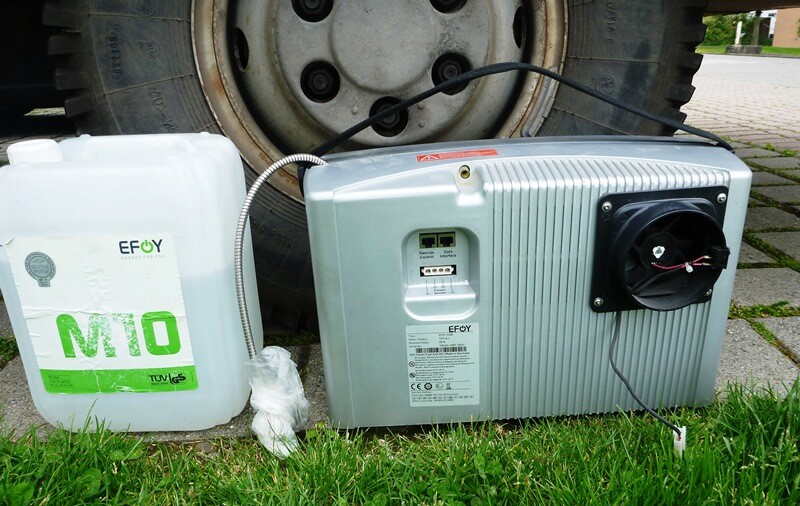
https://www.efoy.com/
We had one of these when we toured Europe in a motorhome for 3 years some years back.
Made about the same noise as a compressor fridge, can be used inside the motorhome, a little CO2 and some pure water are the only waste products and will run 24/7.
Cheers,
Peter
They used to be available here and Kimberly Kampers were offering them as an option at one stage.
Get in Touch with Us | Powerbox Australia in Sydney claim to sell them.
And this mob in Melbourne. EFOY Fuel Cells - GreenRen Power
Cheers,
Peter
-- Edited by Peter_n_Margaret on Monday 2nd of February 2026 09:12:38 AM
I ditched alll my solar panels save one, and 2 batteries replaced them with 3.5 Noisy Generator.we
As soon as I start the generator I dont need to conserve power we can run whatever we want.
As one living on a "Kings" budget, I can totally recommend their 360Watt solar blanket(s) I have one and since upgrading the A Van to Lithium, the Redarc now disconnected, I will probably buy a second. They DO give a pretty good 360 Watts and a pair out in the midday sun give way more power than the 30amp mains charger powered by the generator. There are always going to be times of no sun though and I would NOT be without the generator.
It is purely for use as and when needed though rather than a main source of power.
I am finding the 250Watt panel on A Van roof plenty to keep batteries charged in A Van while driving and will not bother with a DC-DC charger until I double the battery size. 120 ah to 24ah.
-- Edited by landy on Monday 2nd of February 2026 10:25:15 PM
I'll take a closer look at that generator tomorrow, off to punch out a few zzzzs now.
Cheers
Brendan
Cheers,
Peter
Lots of solar...............
June 2024 in WA.
It is raining.
5A is enough to run the compressor fridge and the compressor deep freeze.
Rain stopped but still 100% shade from the clouds.
Cloud breaking up and light reflects from the nearby clouds.
Add more solar and you can be happy when others are not.
There is 1160W of solar. The PL60 controller is a 20+ year old PWM.
Cheers,
Peter
-- Edited by Peter_n_Margaret on Tuesday 3rd of February 2026 03:03:28 PM
Peter, in what way are your 1160W of solar hooked up for the 60 amp controller to not be overloaded?
I bet it doesn't.
If the solar harvest exceeds 60A, the controller sheds the excess to protect itself (as many good quality controllers do).
Alternatively, I can switch some panels off if required.
Cheers,
Peter
Unlike most controllers in common use these days, the Plasmatronics units are actually manufactured in Victoria and have been for over 30 years.
They are premium quality products, comply with all Australian standards and provide superior technical back-up.
That PL60 has been in constant use in our OKA for 21 years now.
Plasmatronics - Solar Power Regulators
Cheers,
Peter
Today in Nth Qld os a typical wet season it started heavy rain around 4am to about 7ish where it became regular showers, then around 10am it turned into a tropical storm realy pouring down with a bit of thunder and lightning, visability approx 100m, this eased off around 11 and the constant heavy showers 15-29 minutes all afternoon, its now 7pm with no relief in sight. In between the rain the sky has been leaden grey.
How do your solar system stand up to those conditions.
Thanks Peter.
Your biases are showing Gundog.
Unless you are riding a bicycle, almost every RV has an alternator fitted to the engine. It is designed specifically to charge batteries and makes a very effective and cheap back-up electrical energy supply on the rare occasions that plenty of solar does not supply what you need.
How you organise that to happen is a choice that you can make. You could use a set of jumper leads or a DC-DC charger or a permanent direct connection, as I do.
Any time the OKA engine is running, I can charge the (lithium, and before them the AGM) house batteries directly from the alternator whether driving or stationary.
Cheers,
Peter
Anywhere can have bad weather. If the forecast is for a week, or more, we go somewhere else. That is the beauty of having wheels.
We were once in Kununurra and it was 38C and raining. 2 days later we were on the Queensland coast 10C cooler. You do have choices.
And we have motor homed in Scotland. It is a wonderful destination with free camping available in most areas (unlike England) and very friendly people.
We drove 3,200km in 3 1/2 weeks. Cool temperatures make for good solar collection and lower fridge consumption.
Cheers,
Peter
Perhaps you would point me to their compliance for AS61000-6-3 which is required in Australia?
You being obsessive about compliance to standards.
__________________________________________________________________________________________________________________________________
You can search as easily as I can, I have no wish to satisfy your problem.
Do you actually imagine a 30 year Australian specialist in these products not complying with Australian regulations?
Cheers,
Peter
I don't Think a Controller that was installed 21 years ago, needs to be compliant with a Standard AS61.... that was introduced in Oct 22, 2021.
But if it was replaced with a new controller thats another story.
You can be less sure that this happens with imported products, particularly if purchased on Ebay and the like.
Cheers,
Peter
For those interested in direct charging your house battery from the alternator, I just took some pics to show the effect.
The house battery is a 326Ah CALB LiFePO4 with 250A Daly BMS and the crank battery is a FullRiver HC75 cranking AGM, 930CCA.
The alternator is a bog standard 85A Bosch.
This is what I see in the OKA cab.
From the left, LEDs show crank battery voltage, house battery voltage, Amps (green) flowing from the alternator to the house battery.
The switches activate a VSR relay that can be locked closed manually (does not need to be a VSR type relay).
Ignition ON, engine not running.
Engine running, at idle speed, shows alternator output voltage.
Engine running, at idle speed, with relay closed and locked. Shows apparent crank battery and house battery voltages and the Amps of charge going into the house battery. These voltages will both climb to 14.3V as the house battery becomes more charged.
The charge rate into the house batteries will vary with the difference in voltage between the house battery and the alternator. In this example that difference was only 1.5V. If the difference is larger, the charge rate will be greater. As the voltage difference reduces, so will the charge rate. Increasing the engine RPM makes little difference.
This arrangement is very effective. The alternator voltage is ideal for LA or LiFePO4 batteries. To get the best result it requires a decent cable between the Crank and house batteries, a relay, a couple of cheap volt meters and a Hall effect ammeter to see the result.
This will also run in reverse. If the crank battery is flat for some reason, it can be charged from the house battery and solar by closing the relay with the engine off, something you can not do with a DC-DC charger.
Cheers,
Peter
-- Edited by Peter_n_Margaret on Saturday 7th of February 2026 05:10:51 PM
I have both. Generator is a 1000Watt Inverter. It is quiet but i would only use it when it would not be a bother to others. I also have 3 x 65 Ah LiFePo that are east in put out in the sun under a portable 120Watt panel. Or behind a tree or suitable noise barrier with the generator if i need to. Generator use is a no brainer if you take time to think about how to use it without imposing on fellow campers.
Years ago B4 Solar, had a Gennie enclosure for our Honda 20i ( 2000 watt) that looked like a little hut. The 4 sides were hinged in such a way they could be folded flat. The gable roof was hinged to the rear/back side. The shorter sides only went as high as the front and rear sides to allow heat to escape under the gable.
All in-sides and the roof were covered with thick carpet.
Definitely reduced gennie noise.