Apologies in advance for the elementary question, but I'm wondering about the best anchor point for the cable. When I collected the van the dealer just hooked it onto the safety chain D shackle, which surely can't be right. Also, my cable is quite long and I'm concerned about it getting tangled. So guys, where/how do you anchor yours to the car?
The Belmont Bear said
10:44 AM Apr 22, 2017
Hi Tony, I currently have my breakaway hooked up in the same way and I remember when I picked up the van that they told me it should only be a temporary measure, I needed a have a proper connection point. I will be interested in the response that you get from others as I'm sure this is would be a common thing for first time van owners and I don't know the effectiveness or even the legality of connecting it this way.
cheers BB
-- Edited by The Belmont Bear on Saturday 22nd of April 2017 10:44:39 AM
rgren2 said
11:44 AM Apr 22, 2017
I have a connector (used to be a CB aerial mudguard mount for my hilux) attached to the area where the tie down point was on the back of my Patrol.
iana said
12:15 PM Apr 22, 2017
The breakaway cable should be attached to any strong structure on the vehicle, but not a D shackle holding the towed vehicle safety chain.
SouthernComfort said
12:20 PM Apr 22, 2017
The more I think about it, logically it has to be anchored to the car proper. If the whole towbar caboodle ever came adrift (unlikey, but....) there's no point having the cable fastened to any part of it. I'm going to find a spot to shackle the cable to the chassis somewhere. I wonder how many people are driving around blissfully unaware - it's a bit scary!
Radar said
01:35 PM Apr 22, 2017
SouthernComfort wrote:
Apologies in advance for the elementary question, but I'm wondering about the best anchor point for the cable. When I collected the van the dealer just hooked it onto the safety chain D shackle, which surely can't be right. Also, my cable is quite long and I'm concerned about it getting tangled. So guys, where/how do you anchor yours to the car?
I did ask this question back end of 2016, what I did mainly because I like to see what I am trying to achieve, I drill a hole in the chrome bumper not super strong but would be strong enough. Put a 1/4 dia eye bolt to hook up the cable to.
In the photo I have used a bungie strap to illustrate, simple as.
Remember the wire is light and really don't need anything super strong.
On my Patrol I shackle breakaway cable to Tie Down fitted to centre of rear step (OEM).
What make is your tug? To give best advice this is needed, then someone with similar could advise how they do it.
SouthernComfort said
04:57 PM Apr 22, 2017
Possum3 wrote:
On my Patrol I shackle breakaway cable to Tie Down fitted to centre of rear step (OEM). What make is your tug? To give best advice this is needed, then someone with similar could advise how they do it.
I have a Territory and there isn't much to play with underneath. I think a shackle on the back end of spare wheel cradle would be OK, it's not exactly a chassis point but more than strong enough to do the trick, and it's accessible.
Still, I'd be interested to know what other Terri owners have done.
Cupie said
10:56 PM Apr 22, 2017
I use the large tiedown/tow point on my Patrol.
I coil up the excess cable & tie it off with a small cable tie.
macka17 said
12:47 PM Apr 23, 2017
Just remember. IF it (the tow hitch). Does breakaway.
Have cable anchored to something substantial.
Make sure it DOES pull the pin.
-- Edited by macka17 on Sunday 23rd of April 2017 12:48:18 PM
Warren-Pat_01 said
10:12 PM Apr 23, 2017
Can I ask the question? Has anyone ever dropped/lost a tow bar?
I've heard of Prado couplings breaking & I've had the 50mm ball come loose twice on two trips with my current van - didn't get to the stage where I had to rely on the chains. This is part of the reason why I recently queried off-road couplings.
kezngaz said
10:13 AM Apr 24, 2017
We run ours throught the top handle on the hitch then down to the right side and D shackle it to the tow eye.
Depending on vehicle will depend on wheres accessable.
You can always adjust lenth of wire to suit, but always fix away from tow bar structure, just in case.
Hope this helps.
Kezngaz.
macka17 said
06:02 PM Apr 24, 2017
Warren. Put some "locktite" on the nut mate (ball) Or clear silicon. You not tightening it enuff.
26\28mm ringie from memory. I always carry one. (Justin') Loong spanner. Plenty of lean.
Oh.
You do have a spring washer there. Don't you.
Flat illegal, (or should be)
-- Edited by macka17 on Monday 24th of April 2017 06:03:39 PM
Should the towbar assembly INCLUDING the tow ball become disengaged from the vehicle then affixing the breakaway cable in that location will achieve absolutely nothing.
The whole towing 'mechanism' - towbar, towball, towing chains AND the breakaway cable will all head south at a rate of knots without the breakaway cable removing the clip from the mechanism - therefore operating the van's brakes. Consequently, the van will be heading south along with the whole kit and kaboodle
This, I feel, is the correct application of attachment of the breakaway cable to the vehicle -
Obviously, many can, and probably will, disagree with my opinion - so be it.
Cheers - John
-- Edited by rockylizard on Monday 24th of April 2017 09:22:58 PM
Cupie said
10:21 PM Apr 24, 2017
rockylizard wrote:
Gday...
I have issue with the pommie AL-KO advice .
Should the towbar assembly INCLUDING the tow ball become disengaged from the vehicle then affixing the breakaway cable in that location will achieve absolutely nothing.
The whole towing 'mechanism' - towbar, towball, towing chains AND the breakaway cable will all head south at a rate of knots without the breakaway cable removing the clip from the mechanism - therefore operating the van's brakes. Consequently, the van will be heading south along with the whole kit and kaboodle
This, I feel, is the correct application of attachment of the breakaway cable to the vehicle -
Obviously, many can, and probably will, disagree with my opinion - so be it.
Cheers - John
-- Edited by rockylizard on Monday 24th of April 2017 09:22:58 PM
I for one agree ...
In fact I use the method described in your link ..
"Some tow vehicles like the Nissan Patrol have a convenient place to attach the break-away cable (recovery eye under the rear doors) which is not connected to the towbar but most dont."
SouthernComfort said
09:04 AM Apr 25, 2017
rockylizard wrote:
Gday...
I have issue with the pommie AL-KO advice .
Should the towbar assembly INCLUDING the tow ball become disengaged from the vehicle then affixing the breakaway cable in that location will achieve absolutely nothing.
The whole towing 'mechanism' - towbar, towball, towing chains AND the breakaway cable will all head south at a rate of knots without the breakaway cable removing the clip from the mechanism - therefore operating the van's brakes. Consequently, the van will be heading south along with the whole kit and kaboodle
This, I feel, is the correct application of attachment of the breakaway cable to the vehicle -
Obviously, many can, and probably will, disagree with my opinion - so be it.
Cheers - John
I know a little about British (and Continental) hitches, and they are different to ours. The set-up has only 2 parts, the extended neck tow ball is all one piece double bolted direct to bar, in turn bolted direct to chassis. Ours has 4 components - bar, tow head/neck, retaining pin and separate ball. Their van's are also constructed with much lighter chassis and ball weights than our heavy rigs.
Obviously AL-KO meets local UK regulations but on any of these matters I prefer to focus on equipment used in AU plus local regs. Working to overseas systems and regs is dangerous when differences exist in both, same goes for many other technical / engineering matters.
-- Edited by rockylizard on Monday 24th of April 2017 09:22:58 PM
rockylizard said
09:24 AM Apr 25, 2017
SouthernComfort wrote:
I know a little about British (and Continental) hitches, and they are different to ours. The set-up has only 2 parts, the extended neck tow ball is all one piece double bolted direct to bar, in turn bolted direct to chassis. Ours has 4 components - bar, tow head/neck, retaining pin and separate ball. Their van's are also constructed with much lighter chassis and ball weights than our heavy rigs.
Obviously AL-KO meets local UK regulations but on any of these matters I prefer to focus on equipment used in AU plus local regs. Working to overseas systems and regs is dangerous when differences exist in both, same goes for many other technical / engineering matters.
Gday...
Please consider -
if just the tow ball breaks then the chains will catch the van,
if the tow tongue comes adrift from the tow bar then the chains will catch the van,
if the retaining pin breaks/falls out then the chains will catch the van.
However, the use of a breakaway system is to address the situation where the "entire towing mechanism" that joins the van to the vehicle should come adrift from the vehicle - ie the bolts holding the tow bar to the chassis fail/fall out/break.
Given the description you provide for the UK and Continental towing systems, then connecting the breakaway cable to the tow ball (tow neck) as in the video would prove useless should the situation that has promoted the mandatory use of a breakaway system occur.
Again, I defer to the article in the following link - the breakaway cable MUST be connected to a part of the vehicle that is NOT connected or associated with the "towing mechanism". Any other connection to either the towball, tow tongue, towbar is completely negating the purpose of the breakaway system.
Obviously, many can (and probably will) disagree with my opinion - so be it. However, before disagreement fills your mind, spend a moment to logically go through the scenario. Like SouthernComfort, I prefer to follow local regs and logic.
Cheers - John
SouthernComfort said
11:14 AM Apr 25, 2017
rockylizard wrote:
SouthernComfort wrote:
I know a little about British (and Continental) hitches, and they are different to ours. The set-up has only 2 parts, the extended neck tow ball is all one piece double bolted direct to bar, in turn bolted direct to chassis. Ours has 4 components - bar, tow head/neck, retaining pin and separate ball. Their van's are also constructed with much lighter chassis and ball weights than our heavy rigs.
Obviously AL-KO meets local UK regulations but on any of these matters I prefer to focus on equipment used in AU plus local regs. Working to overseas systems and regs is dangerous when differences exist in both, same goes for many other technical / engineering matters.
Gday...
Please consider -
if just the tow ball breaks then the chains will catch the van,
if the tow tongue comes adrift from the tow bar then the chains will catch the van,
if the retaining pin breaks/falls out then the chains will catch the van.
However, the use of a breakaway system is to address the situation where the "entire towing mechanism" that joins the van to the vehicle should come adrift from the vehicle - ie the bolts holding the tow bar to the chassis fail/fall out/break.
Given the description you provide for the UK and Continental towing systems, then connecting the breakaway cable to the tow ball (tow neck) as in the video would prove useless should the situation that has promoted the mandatory use of a breakaway system occur.
Again, I defer to the article in the following link - the breakaway cable MUST be connected to a part of the vehicle that is NOT connected or associated with the "towing mechanism". Any other connection to either the towball, tow tongue, towbar is completely negating the purpose of the breakaway system.
Obviously, many can (and probably will) disagree with my opinion - so be it. However, before disagreement fills your mind, spend a moment to logically go through the scenario. Like SouthernComfort, I prefer to follow local regs and logic.
Cheers - John
I think most are in general agreement, but the thing is John, logic needs to extend beyond where the BA cable is coupled to the car. If we're satisfied that fastening it direct to chassis mitigates the potential disaster of a tow hitch becoming detached by successfully stopping the van, we've still only done part of the job. Relying on the BA device to save the day should be the very last and highly unlikely resort, because if it does happen it will still mean something bad has happened either to car, van, or possibly other property and life. The integrity of the hitch also needs to be regularly monitored (e.g. at annual servicing, at the very least) and I'm betting that is seldom done, simply because we have no mandatory requirement for formal vehicle safety checks in this country. The UK has compulsory annual MoT (RWC) checks on vehicles which must include towing hitches where fitted. Now, if we had that....
rockylizard said
11:30 AM Apr 25, 2017
Gday...
Tony, it isn't rocket science
This piece of advice from the link I provided gives clear indication where to connect the breakaway cable.
"Some tow vehicles like the Nissan Patrol have a convenient place to attach the break-away cable (recovery eye under the rear doors) which is not connected to the towbar but most dont. On my own vehicle I have fitted a small stainless steel eye-strap to the plastic rear bumper bar (yes, plastic) onto which I attach the break-away cable via a small stainless steel shackle. Even though these are small in size they provide more than enough strength to pull the pin from the break-away switch."
Either drill a small hole in some part at the rear or the car (even to the plastic surround) and use either a small D-shackle or carabiner (like this) and clip the cable to that.
Just NOT to any part of the "towing mechanism"
I am fortunate there is a 'tow/recovery eye' attached to the chassis of my Discovery - so I utilise it (otherwise I would have simply drilled a hole in that grey plastic surround below the 'tow/recovery eye' -
Cheers - John
[edit: PS - agreed. Checking tightness of tow ball nut, bolts holding towbar/tongue etc should all be part of our 'routine'. But these days it seems few seem to do the old POWER check - Petrol/diesel, oil, water, electrics, rubber. So to have to get 'down and dirty' and run a spanner over those very important bolts/nuts/connections on the "towing mechanism" rarely gets a look in. Perhaps, discussions on forums and then at 'campfire chats'(dare I call them happy hours) may spread the news]
-- Edited by rockylizard on Tuesday 25th of April 2017 11:41:18 AM
Radar said
05:12 PM Apr 25, 2017
Hi Rocklizard.
Looks like you and I are the only 2 who can supply a photo of how we handle the need to attach the cord to reason spot at the rear.
Good work.
Warren-Pat_01 said
10:53 PM Apr 26, 2017
G'day macca,
Yes, I have a spring washer on my 50mm ball & yes, I lean on the spanner (approx. 18" long). I'll add the locktite next time.
When we went to England a few years ago I was amazed with the caravans over there. I even took pictures of the set ups as they had the piddly little tow balls as shown above & NO safety chains! All they had was what I've since learnt is the break-away cable connected.
Granted there were not many vans on the roads there - most were in van parks. The Poms (my apologies to any ex-UK people on here) have a different outlook to us as far as their holidays go.
Also 4WDs were quite uncommon - I recall seeing one Nissan Patrol, a couple of Toyota LCs, & quite a few Range Rovers - some of which were in the outside lane of the motorways travelling at what ever they could do. The speed limit was 70 mph, I took our hire car to just over 85 mph once & they were still pulling away!
aussietraveller said
10:47 AM Apr 27, 2017
I have mine connected to the tow hook on the back of the Pajero as per photo, all hooked up as we leave for a relaxing week at Swansea tomorrow with some mates.
Apologies in advance for the elementary question, but I'm wondering about the best anchor point for the cable. When I collected the van the dealer just hooked it onto the safety chain D shackle, which surely can't be right. Also, my cable is quite long and I'm concerned about it getting tangled. So guys, where/how do you anchor yours to the car?
Hi Tony, I currently have my breakaway hooked up in the same way and I remember when I picked up the van that they told me it should only be a temporary measure, I needed a have a proper connection point. I will be interested in the response that you get from others as I'm sure this is would be a common thing for first time van owners and I don't know the effectiveness or even the legality of connecting it this way.
cheers BB
-- Edited by The Belmont Bear on Saturday 22nd of April 2017 10:44:39 AM
I have a connector (used to be a CB aerial mudguard mount for my hilux) attached to the area where the tie down point was on the back of my Patrol.
I did ask this question back end of 2016, what I did mainly because I like to see what I am trying to achieve, I drill a hole in the chrome bumper not super strong but would be strong enough. Put a 1/4 dia eye bolt to hook up the cable to.
In the photo I have used a bungie strap to illustrate, simple as.
Remember the wire is light and really don't need anything super strong.
Hope this helps.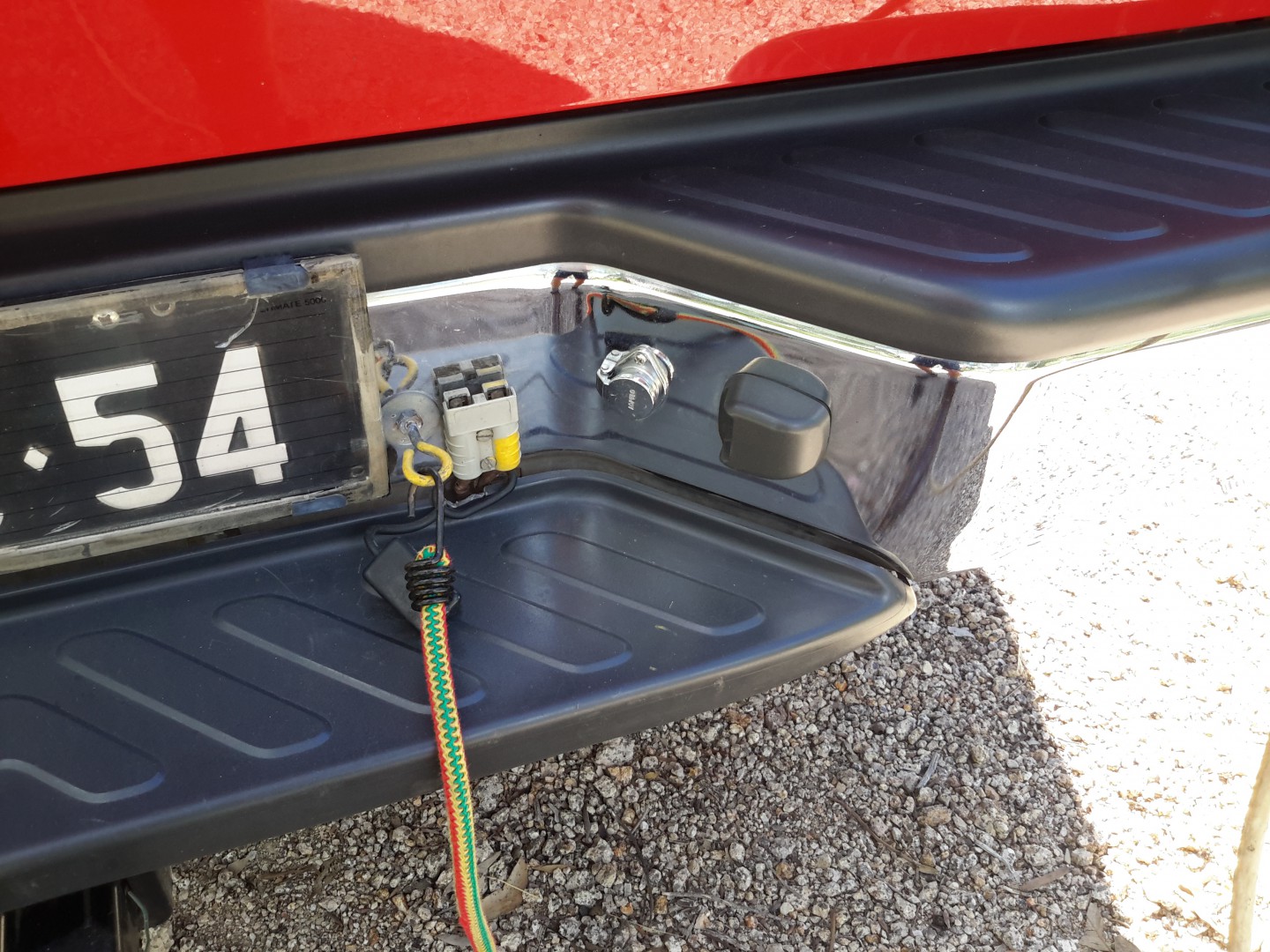
What make is your tug? To give best advice this is needed, then someone with similar could advise how they do it.
I have a Territory and there isn't much to play with underneath. I think a shackle on the back end of spare wheel cradle would be OK, it's not exactly a chassis point but more than strong enough to do the trick, and it's accessible.
Still, I'd be interested to know what other Terri owners have done.
I use the large tiedown/tow point on my Patrol.
I coil up the excess cable & tie it off with a small cable tie.
Just remember.
IF it (the tow hitch). Does breakaway.
Have cable anchored to something substantial.
Make sure it DOES pull the pin.
-- Edited by macka17 on Sunday 23rd of April 2017 12:48:18 PM
I've heard of Prado couplings breaking & I've had the 50mm ball come loose twice on two trips with my current van - didn't get to the stage where I had to rely on the chains. This is part of the reason why I recently queried off-road couplings.
Depending on vehicle will depend on wheres accessable.
You can always adjust lenth of wire to suit, but always fix away from tow bar structure, just in case.
Hope this helps.
Kezngaz.
Warren.
Put some "locktite" on the nut mate (ball)
Or clear silicon.
You not tightening it enuff.
26\28mm ringie from memory.
I always carry one. (Justin')
Loong spanner. Plenty of lean.
Oh.
You do have a spring washer there. Don't you.
Flat illegal, (or should be)
-- Edited by macka17 on Monday 24th of April 2017 06:03:39 PM
Gday...
I have issue with the pommie AL-KO advice .
.
Should the towbar assembly INCLUDING the tow ball become disengaged from the vehicle then affixing the breakaway cable in that location will achieve absolutely nothing.
The whole towing 'mechanism' - towbar, towball, towing chains AND the breakaway cable will all head south at a rate of knots without the breakaway cable removing the clip from the mechanism - therefore operating the van's brakes. Consequently, the van will be heading south along with the whole kit and kaboodle
This, I feel, is the correct application of attachment of the breakaway cable to the vehicle -
http://www.candm.com.au/the-simple-breakaway-cable-mistake-so-many-make/
Obviously, many can, and probably will, disagree with my opinion - so be it.
Cheers - John
-- Edited by rockylizard on Monday 24th of April 2017 09:22:58 PM
I for one agree ...
In fact I use the method described in your link ..
"Some tow vehicles like the Nissan Patrol have a convenient place to attach the break-away cable (recovery eye under the rear doors) which is not connected to the towbar but most dont."
Gday...
Please consider -
However, the use of a breakaway system is to address the situation where the "entire towing mechanism" that joins the van to the vehicle should come adrift from the vehicle - ie the bolts holding the tow bar to the chassis fail/fall out/break.
Given the description you provide for the UK and Continental towing systems, then connecting the breakaway cable to the tow ball (tow neck) as in the video would prove useless should the situation that has promoted the mandatory use of a breakaway system occur.
Again, I defer to the article in the following link - the breakaway cable MUST be connected to a part of the vehicle that is NOT connected or associated with the "towing mechanism". Any other connection to either the towball, tow tongue, towbar is completely negating the purpose of the breakaway system.
http://www.candm.com.au/the-simple-breakaway-cable-mistake-so-many-make/
Obviously, many can (and probably will) disagree with my opinion - so be it. However, before disagreement fills your mind, spend a moment to logically go through the scenario. Like SouthernComfort, I prefer to follow local regs and logic.
Cheers - John
I think most are in general agreement, but the thing is John, logic needs to extend beyond where the BA cable is coupled to the car. If we're satisfied that fastening it direct to chassis mitigates the potential disaster of a tow hitch becoming detached by successfully stopping the van, we've still only done part of the job. Relying on the BA device to save the day should be the very last and highly unlikely resort, because if it does happen it will still mean something bad has happened either to car, van, or possibly other property and life. The integrity of the hitch also needs to be regularly monitored (e.g. at annual servicing, at the very least) and I'm betting that is seldom done, simply because we have no mandatory requirement for formal vehicle safety checks in this country. The UK has compulsory annual MoT (RWC) checks on vehicles which must include towing hitches where fitted. Now, if we had that....
Gday...
Tony, it isn't rocket science
This piece of advice from the link I provided gives clear indication where to connect the breakaway cable.
"Some tow vehicles like the Nissan Patrol have a convenient place to attach the break-away cable (recovery eye under the rear doors) which is not connected to the towbar but most dont. On my own vehicle I have fitted a small stainless steel eye-strap to the plastic rear bumper bar (yes, plastic) onto which I attach the break-away cable via a small stainless steel shackle. Even though these are small in size they provide more than enough strength to pull the pin from the break-away switch."
Either drill a small hole in some part at the rear or the car (even to the plastic surround) and use either a small D-shackle or carabiner (like this) and clip the cable to that.
Just NOT to any part of the "towing mechanism"
I am fortunate there is a 'tow/recovery eye' attached to the chassis of my Discovery - so I utilise it (otherwise I would have simply drilled a hole in that grey plastic surround below the 'tow/recovery eye' -
Cheers - John
[edit: PS - agreed. Checking tightness of tow ball nut, bolts holding towbar/tongue etc should all be part of our 'routine'. But these days it seems few seem to do the old POWER check - Petrol/diesel, oil, water, electrics, rubber. ) may spread the news]
So to have to get 'down and dirty' and run a spanner over those very important bolts/nuts/connections on the "towing mechanism" rarely gets a look in.
Perhaps, discussions on forums and then at 'campfire chats' (dare I call them happy hours
-- Edited by rockylizard on Tuesday 25th of April 2017 11:41:18 AM
Hi Rocklizard.
Looks like you and I are the only 2 who can supply a photo of how we handle the need to attach the cord to reason spot at the rear.
Good work.
Yes, I have a spring washer on my 50mm ball & yes, I lean on the spanner (approx. 18" long). I'll add the locktite next time.
When we went to England a few years ago I was amazed with the caravans over there. I even took pictures of the set ups as they had the piddly little tow balls as shown above & NO safety chains! All they had was what I've since learnt is the break-away cable connected.
Granted there were not many vans on the roads there - most were in van parks. The Poms (my apologies to any ex-UK people on here) have a different outlook to us as far as their holidays go.
Also 4WDs were quite uncommon - I recall seeing one Nissan Patrol, a couple of Toyota LCs, & quite a few Range Rovers - some of which were in the outside lane of the motorways travelling at what ever they could do. The speed limit was 70 mph, I took our hire car to just over 85 mph once & they were still pulling away!
I have mine connected to the tow hook on the back of the Pajero as per photo, all hooked up as we leave for a relaxing week at Swansea tomorrow with some mates.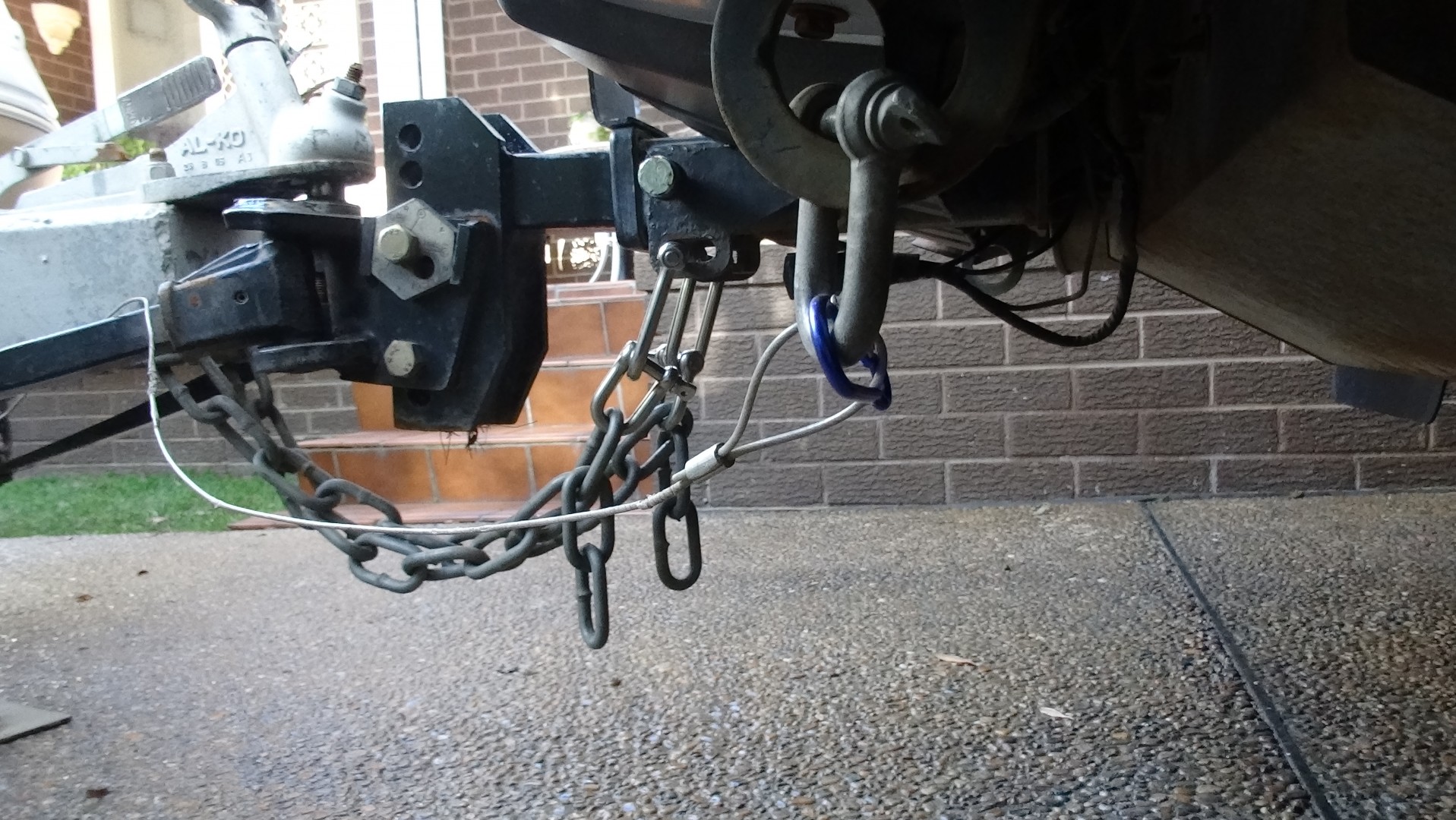
Oh David .. Wait for all the comments about your shackles on the chains.
(I run all my cables through the handle on the coupling).
I suppose that I'll have to go to the trouble of hooking mine up so that I can post a picture .. and open myself up to criticism too.