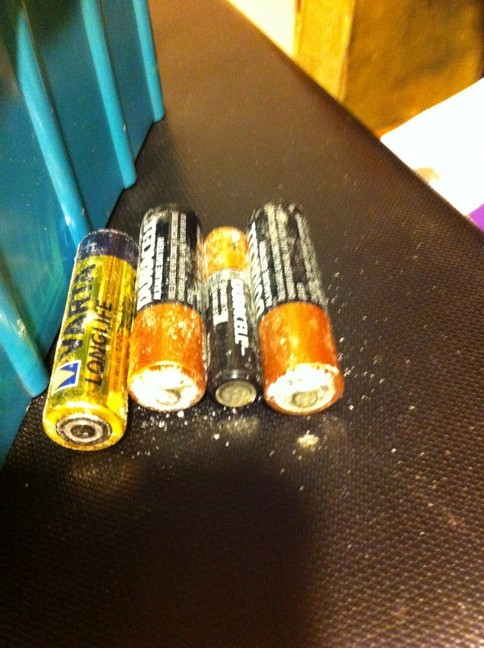
At home I store new dry cell batteries loose in a plastic lidless container and inside a cupboard. I've done this for years and never had a problem except for the last few months when I've noticed a powdery deposit similar to a leaky battery (but dry) on some battery ends and on the outside of batteries - not all but most. All batteries are still above 1.5V and use by dates well in the future. None are swollen as happens when a battery leaks.
So I'm not sure what is happening - possibly some acid substance in the form of a vapour is leaking from a battery?? Any suggestions?
I had a similar problem recently, I had stored some "Dick Smith" batteries with a mixture of other well known brands. It seems that the DS batteries had somehow contaminated the other ones?
rgren2 said
09:26 PM May 19, 2018
It might be a cellular disease.
Tony Bev said
09:45 PM May 19, 2018
I try to leave them in their original packets, hako
Snip the end of the packet, and then put a bit of sticky tape to close packet, and then in a plastic container
I have had them corrode, with the white dry paste showing
For every thirty I buy, (usually from Bunnings), I may lose one a year, perhaps a bit less
In five years I have probably thrown away four leaking batteries
Normal alkaline batteries are suppose to have a shelf life of some years, perhaps they are not designed for vibrations.
Perhaps they have been on the shelf for some years, before we purchase them
My research about eight years ago, said that Varta (German made, sold at Bunnings), were as good as any other AAA, AA, and A batteries
Aus-Kiwi said
10:23 PM May 19, 2018
Moisture . Store in jar with silica pillow .
Dickodownunder said
07:33 AM May 20, 2018
During my working life we used instruments that were in the most battery powered.
I had the same problem whereby employees would come to me with new batteries similar to the condition pictured.
What I did was pack the number of batteries required for each instrument in a vacuum sealed bag and seal it then when the batteries were needed the pack was opened and the correct type and number were available to the operator.
I still do this now when possible, even if it is only for the remote controllers and clocks etc.
Doing this saved my employees putting leaky batteries into expensive equipment and it saved in bit in unnecessary battery purchases and probably saved from the employees oportunity to pilfer company batteries.
outlaw40 said
03:23 PM May 20, 2018
Was told years ago that storing them in the fridge help slow down self discharge. True or not thats how i have stored mine for years and never had a problem
Aus-Kiwi said
03:44 PM May 20, 2018
I guess they have limited shelf life ? We stored them above hot water system in NZ as most homes have hws beside linen cupboard . Dry and warm .
WAssa41 said
08:07 AM May 21, 2018
been storing batteries in the fridge for years helps slow down the natural discharge
Wassa
hako said
08:29 PM May 21, 2018
I think what I'm going to do is stop buying batteries in bulk packs. My wife Joy would kill me if I stored them in the fridge!
Thanks for all the comments.
Regards
Hylife said
09:56 PM May 21, 2018
You gotta be nuts storing them like that!!
If any of the terminals make contact with the metallic foil wrapped around other cells they could short with disastrous consequences.
The foil covering is usually a direct circuit to the negative terminal of the cell. There is a thin insulating washer found between the foil wrapping and the positive terminal of each cell.
Vibrations will wear off the thin plastic coating of the foil wrapping.
Vibrations will also cause the cells to loose their normally air tight seal and the electrolyte will weep and dry out leaving behind the powdery substance you are seeing, just like an old battery does.
hako said
02:03 PM May 22, 2018
Hylife wrote:
You gotta be nuts storing them like that!! If any of the terminals make contact with the metallic foil wrapped around other cells they could short with disastrous consequences. The foil covering is usually a direct circuit to the negative terminal of the cell. There is a thin insulating washer found between the foil wrapping and the positive terminal of each cell. Vibrations will wear off the thin plastic coating of the foil wrapping. Vibrations will also cause the cells to loose their normally air tight seal and the electrolyte will weep and dry out leaving behind the powdery substance you are seeing, just like an old battery does.
That makes sense to me and must be what led to the leakage.
At home I store new dry cell batteries loose in a plastic lidless container and inside a cupboard. I've done this for years and never had a problem except for the last few months when I've noticed a powdery deposit similar to a leaky battery (but dry) on some battery ends and on the outside of batteries - not all but most. All batteries are still above 1.5V and use by dates well in the future. None are swollen as happens when a battery leaks.
So I'm not sure what is happening - possibly some acid substance in the form of a vapour is leaking from a battery?? Any suggestions?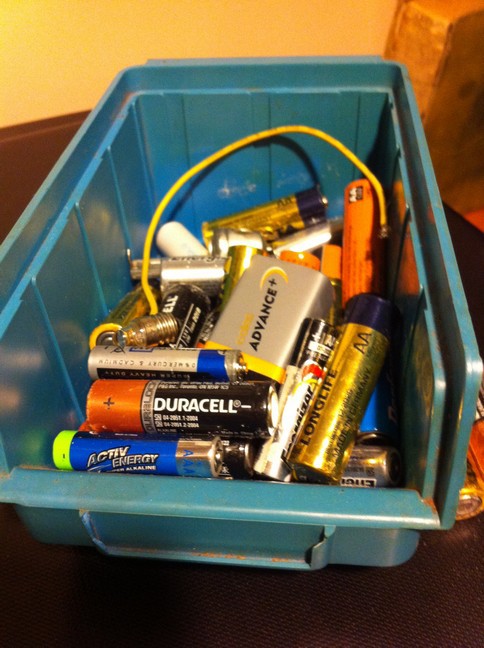
Regards
It might be a cellular disease.
Snip the end of the packet, and then put a bit of sticky tape to close packet, and then in a plastic container
I have had them corrode, with the white dry paste showing
For every thirty I buy, (usually from Bunnings), I may lose one a year, perhaps a bit less
In five years I have probably thrown away four leaking batteries
Normal alkaline batteries are suppose to have a shelf life of some years, perhaps they are not designed for vibrations.
Perhaps they have been on the shelf for some years, before we purchase them
My research about eight years ago, said that Varta (German made, sold at Bunnings), were as good as any other AAA, AA, and A batteries
I had the same problem whereby employees would come to me with new batteries similar to the condition pictured.
What I did was pack the number of batteries required for each instrument in a vacuum sealed bag and seal it then when the batteries were needed the pack was opened and the correct type and number were available to the operator.
I still do this now when possible, even if it is only for the remote controllers and clocks etc.
Doing this saved my employees putting leaky batteries into expensive equipment and it saved in bit in unnecessary battery purchases and probably saved from the employees oportunity to pilfer company batteries.
been storing batteries in the fridge for years helps slow down the natural discharge
Wassa
Thanks for all the comments.
Regards
If any of the terminals make contact with the metallic foil wrapped around other cells they could short with disastrous consequences.
The foil covering is usually a direct circuit to the negative terminal of the cell. There is a thin insulating washer found between the foil wrapping and the positive terminal of each cell.
Vibrations will wear off the thin plastic coating of the foil wrapping.
Vibrations will also cause the cells to loose their normally air tight seal and the electrolyte will weep and dry out leaving behind the powdery substance you are seeing, just like an old battery does.
That makes sense to me and must be what led to the leakage.
Thanks