Hi well I am hoping someone can help a novice, I have a 120ah deep cycle battery hooked up all 12v lights work fine. but when I turned the fridge to 12v nothing has happened.
It worked on 240v when power was hooked up. Is it anything to do with the centurian power set-up? If so can I turn that off?
cheers Barry.
erad said
02:35 PM Jun 4, 2019
There are two electrical elements in the fridge - one for 240 V and one for 12 V. Failure to operate on 12 V could be a blown element, or a bad electrical connection. Having only 12 volts means that for the same power input to the fridge means about 20 times the current. Any resistance in cable joints becomes more critical, because the voltage drop varies as per the square of the current, so it doesn't take much for the 12 v system to either not work, or to work poorly. Even if the cable connections are OK, the cabling wires may be too small, in which case the voltage drop caused by 20 squared (=400 times) becomes significant. Get the system checked out. if it did work OK once, and now does not work, almost certainly it will be a wire fallen off or the element will be blown.
denmonkey said
03:05 PM Jun 4, 2019
has it worked on 12v before?
Whenarewethere said
05:08 PM Jun 4, 2019
Did you check you system with a multimeter?
If it is a compressor fridge it will only use about 4 to 6 amps while actually running. If it is a gas fridge I believe current is about 12 amps & continuous!
Margaret and Barry said
05:47 PM Jun 4, 2019
ok I have had the van a few days only. ill check amps toomorrow its a 3way fridge , 12 amps constant isnt much good for free camping is it? what options do I have.
cheers Barry
blaze said
06:00 PM Jun 4, 2019
gas
cheers
blaze
TheHeaths said
07:35 PM Jun 4, 2019
If it is a 3 way fridge, it is probably only wired for 12 volt when connected to the car. This is done as the 12 volt draw is too high for reasonable usage on battery power, as you can see from the current usages quoted by others.
Normally a 3 way would be operated on gas when free camping.
Cupie said
11:15 PM Jun 4, 2019
TheHeaths wrote:
If it is a 3 way fridge, it is probably only wired for 12 volt when connected to the car. This is done as the 12 volt draw is too high for reasonable usage on battery power, as you can see from the current usages quoted by others.
Normally a 3 way would be operated on gas when free camping.
Agree 100%.
The standard Jayco Westport 12v input to the 3 way fridge is via the 7 pin plug .. crazy. It will never work on that cct & will have to be wired from the vehicle alternator with appropriate heavy duty cable via an isolator of some sort and connected by an anderson plug.
At best, all the 12v option does & is designed to do, is to try and maintain the fridge temp when travelling, using the vehicle's alternator as the power source.
Olive Oil said
05:10 AM Jun 5, 2019
The 12v is for when it's connected to the car while travelling.
If you had it running on 12v while stationary it would flatten the caravan battery very quickly.
Gas is the way to go. Our 90L fridge gets 9 days on a 4kg gas bottle, about $2 per day.
Margaret and Barry said
08:54 AM Jun 5, 2019
Thanks everyone for the great input,
ill be running on gas when free camping and 240v in caravan park
and ill check wiring on 7 pin for travelling.
cheers and thanks Barry
Cupie said
09:47 AM Jun 5, 2019
Margaret and Barry wrote:
Thanks everyone for the great input,
ill be running on gas when free camping and 240v in caravan park
and ill check wiring on 7 pin for travelling.
cheers and thanks Barry
Barry ....
It might be a good idea to look into the issue of wiring your vehicle & van to get the 12v side of the fridge to work satisfactorily when driving. (Just google it).
You'll need a battery isolator of some sort in the vehicle as well as heavy wiring (through a cct breaker) to an Anderson plug at the rear of the vehicle that connects via new heavy wiring to the 12v side of the fridge.
It will never work if you try to use the existing wiring through the 7 pin plug. I know, because I have had a Westport since new in 1998.
I find that the 3 way works better when I use some right size plastic storage containers for all the stuff that I keep in the fridge. The correct (labelled) container can be quickly taken from the fridge for use and returned without too much loss of that valuable cool air in the fridge. Any spare space in my fridge is filled with frozen water bottles that I refreeze at camp kitchens overnight. It's also a good idea to fit a shade cloth to the side of the van to keep direct sunlight off the rear of the fridge when camped. BTW the use of plastic containers reduces the incidence of frozen food when the fridge over does its job in winter.
erad said
10:29 AM Jun 5, 2019
We have a 3 way fridge in our caravan. The 12 V supply to the fridge was never a brilliant option - it maintained things "cool" rather than cold. When I bought my current tug (a 2013 Pajero), I used some BTH (Bloody Thick & Heavy) cabling to the auxiliary plug for the caravan, and the difference in performance on 12 V is amazing. Be warned however, that the current draw will easily flatten the tug's battery if the fridge is set to 12 v and the engine is not running. For this reason, I also have fitted a fridge switch - a motion detector which isolates the fridge if the caravan is not moving. A new battery as well in the tug, and thusfar, no flat battery. The fridge draws something like 12 amps, and that is enough to draw down your battery over a period of a few hours.
Whenarewethere said
10:53 AM Jun 5, 2019
Cupie wrote:The correct (labelled) container can be quickly taken from the fridge for use and returned without too much loss of that valuable cool air in the fridge.
I ran our home fridge off our UPS (uninterruptible power supply) for a few days to see how much more power it used when one opens the door. Avoid opening the door as the fridge uses a lot more energy to recover which is no good if don't have plenty of battery backup or limited gas supply.
Work out everything you need before opening the fridge, even have an official Fridge Door Opener so you has more hands so the door is open the least amount of time. Maybe put those things in a small foam box to keep them cooler longer, ie extra cans of beer or various small goods for lunch & then put them all back in the fridge in one go.
This 12 hour graph shows larger yellow blocks when we opened the fridge door & it had to recover.
Cupie wrote:The correct (labelled) container can be quickly taken from the fridge for use and returned without too much loss of that valuable cool air in the fridge.
I ran our home fridge off our UPS (uninterruptible power supply) for a few days to see how much more power it used when one opens the door. Avoid opening the door as the fridge uses a lot more energy to recover which is no good if don't have plenty of battery backup or limited gas supply.
Work out everything you need before opening the fridge, even have an official Fridge Door Opener so you has more hands so the door is open the least amount of time. Maybe put those things in a small foam box to keep them cooler longer, ie extra cans of beer or various small goods for lunch & then put them all back in the fridge in one go.
This 12 hour graph shows larger yellow blocks when we opened the fridge door & it had to recover.
WhenAreWeThere ...Bloody hell, I'd be in deep poo with SWMBO if I tried something like that.
I only have to make an oblique mention of the subject of keeping the door open for as short a time as possible & we have a major incident. She hates the frozen water bottles too, until she wants a cool drink.
But you are perfectly right of course.
edit ... Important stuff like white wine & beer are kept in the Engel.
Erad/Robert .. My solution to the battery flattening issue was to wire in a relay on the accessory side of the ignition switch & use it to connect the Alternator/battery to the 12v lead to the van. Mine has a 30a fuse included in the assembly (circa $5) The relay doesn't operate & connect the van fridge until the engine is started & the key returns to the accessory position. The motion switch that you use is perhaps an even better approach & most RV spares places sell them too.
-- Edited by Cupie on Wednesday 5th of June 2019 11:08:49 AM
Whenarewethere said
11:08 AM Jun 5, 2019
Calculate total wire length for both + & - so it you have a 10 metre run, it is actually 20 metres. I rewired our fridge internally, 1.1 metres + & - of under sized wire, 0.17 voltage drop from its socket to its circuit board.
She hates the frozen water bottles too, until she wants a cool drink.
The more thermal mass in the fridge the better. It stabilizes temperature, & if your fridge fails for some reason it will keep everything colder longer. Also simply a back up emergency supply of water at the very least!
Margaret and Barry said
12:59 PM Jun 5, 2019
Thanks everyone so much to take in but im happy to wire properly and use gas when staying overnight free parking.
cheers Barry
Mamil said
02:33 PM Jun 6, 2019
My 3-way was acting very poorly on 12V - melted ice cream and warm beer on arrival did not make for happy campers!
I investigated what wiring size was used as standard and found the following:-
Car battery to trailer socket: 2.5mm2
Trailer plug to van fuse box: 2.5mm2
Fuse box to fridge: 4mm2
Rewired the whole lot using 16mm2 from car battery all the way to fuse box (with 50A Anderson plug in place of 12 pin trailer socket), and 10mm2 from there to fridge.
I now get more than 13V at the back of the fridge at all times, and main section of fridge holds 3deg. and freezer section -18deg while I'm driving.
As others have already said, it's all about the size of wiring to avoid the dreaded voltage drop.
Whenarewethere said
04:54 PM Jun 6, 2019
There is only one thing I can think of using 2.5mm2 wiring for on caravan manufacturers..... I will leave it at that!
& if one is trying to charge up the caravan battery as well you really need to make sure the wiring is heavy enough.
One wonders what the rest of the thin wiring is like. To me it is starting to look like a fire hazard!
Hi well I am hoping someone can help a novice, I have a 120ah deep cycle battery hooked up all 12v lights work fine. but when I turned the fridge to 12v nothing has happened.
It worked on 240v when power was hooked up. Is it anything to do with the centurian power set-up? If so can I turn that off?
cheers Barry.
Did you check you system with a multimeter?
If it is a compressor fridge it will only use about 4 to 6 amps while actually running. If it is a gas fridge I believe current is about 12 amps & continuous!
cheers Barry
cheers
blaze
Normally a 3 way would be operated on gas when free camping.
Agree 100%.
The standard Jayco Westport 12v input to the 3 way fridge is via the 7 pin plug .. crazy. It will never work on that cct & will have to be wired from the vehicle alternator with appropriate heavy duty cable via an isolator of some sort and connected by an anderson plug.
At best, all the 12v option does & is designed to do, is to try and maintain the fridge temp when travelling, using the vehicle's alternator as the power source.
If you had it running on 12v while stationary it would flatten the caravan battery very quickly.
Gas is the way to go. Our 90L fridge gets 9 days on a 4kg gas bottle, about $2 per day.
ill be running on gas when free camping and 240v in caravan park
and ill check wiring on 7 pin for travelling.
cheers and thanks Barry
Barry ....
It might be a good idea to look into the issue of wiring your vehicle & van to get the 12v side of the fridge to work satisfactorily when driving. (Just google it).
You'll need a battery isolator of some sort in the vehicle as well as heavy wiring (through a cct breaker) to an Anderson plug at the rear of the vehicle that connects via new heavy wiring to the 12v side of the fridge.
It will never work if you try to use the existing wiring through the 7 pin plug. I know, because I have had a Westport since new in 1998.
I find that the 3 way works better when I use some right size plastic storage containers for all the stuff that I keep in the fridge. The correct (labelled) container can be quickly taken from the fridge for use and returned without too much loss of that valuable cool air in the fridge. Any spare space in my fridge is filled with frozen water bottles that I refreeze at camp kitchens overnight. It's also a good idea to fit a shade cloth to the side of the van to keep direct sunlight off the rear of the fridge when camped. BTW the use of plastic containers reduces the incidence of frozen food when the fridge over does its job in winter.
We have a 3 way fridge in our caravan. The 12 V supply to the fridge was never a brilliant option - it maintained things "cool" rather than cold. When I bought my current tug (a 2013 Pajero), I used some BTH (Bloody Thick & Heavy) cabling to the auxiliary plug for the caravan, and the difference in performance on 12 V is amazing. Be warned however, that the current draw will easily flatten the tug's battery if the fridge is set to 12 v and the engine is not running. For this reason, I also have fitted a fridge switch - a motion detector which isolates the fridge if the caravan is not moving. A new battery as well in the tug, and thusfar, no flat battery. The fridge draws something like 12 amps, and that is enough to draw down your battery over a period of a few hours.
I ran our home fridge off our UPS (uninterruptible power supply) for a few days to see how much more power it used when one opens the door. Avoid opening the door as the fridge uses a lot more energy to recover which is no good if don't have plenty of battery backup or limited gas supply.
Work out everything you need before opening the fridge, even have an official Fridge Door Opener so you has more hands so the door is open the least amount of time. Maybe put those things in a small foam box to keep them cooler longer, ie extra cans of beer or various small goods for lunch & then put them all back in the fridge in one go.
This 12 hour graph shows larger yellow blocks when we opened the fridge door & it had to recover.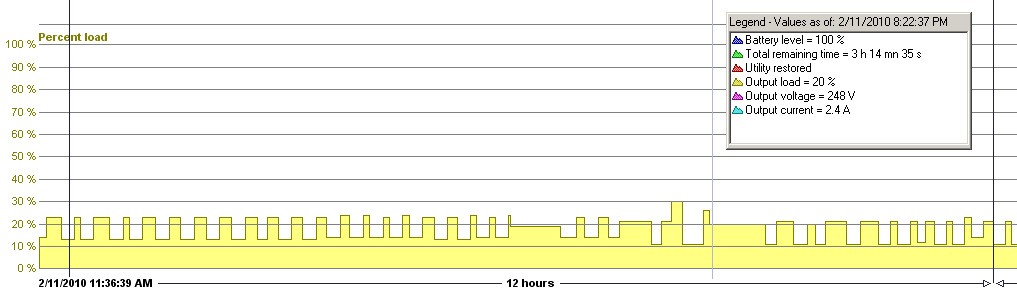
WhenAreWeThere ...Bloody hell, I'd be in deep poo with SWMBO if I tried something like that.
I only have to make an oblique mention of the subject of keeping the door open for as short a time as possible & we have a major incident. She hates the frozen water bottles too, until she wants a cool drink.
But you are perfectly right of course.
edit ... Important stuff like white wine & beer are kept in the Engel.
Erad/Robert .. My solution to the battery flattening issue was to wire in a relay on the accessory side of the ignition switch & use it to connect the Alternator/battery to the 12v lead to the van. Mine has a 30a fuse included in the assembly (circa $5) The relay doesn't operate & connect the van fridge until the engine is started & the key returns to the accessory position. The motion switch that you use is perhaps an even better approach & most RV spares places sell them too.
-- Edited by Cupie on Wednesday 5th of June 2019 11:08:49 AM
Calculate total wire length for both + & - so it you have a 10 metre run, it is actually 20 metres. I rewired our fridge internally, 1.1 metres + & - of under sized wire, 0.17 voltage drop from its socket to its circuit board.
The more thermal mass in the fridge the better. It stabilizes temperature, & if your fridge fails for some reason it will keep everything colder longer. Also simply a back up emergency supply of water at the very least!
cheers Barry
I investigated what wiring size was used as standard and found the following:-
Car battery to trailer socket: 2.5mm2
Trailer plug to van fuse box: 2.5mm2
Fuse box to fridge: 4mm2
Rewired the whole lot using 16mm2 from car battery all the way to fuse box (with 50A Anderson plug in place of 12 pin trailer socket), and 10mm2 from there to fridge.
I now get more than 13V at the back of the fridge at all times, and main section of fridge holds 3deg. and freezer section -18deg while I'm driving.
As others have already said, it's all about the size of wiring to avoid the dreaded voltage drop.
There is only one thing I can think of using 2.5mm2 wiring for on caravan manufacturers..... I will leave it at that!
& if one is trying to charge up the caravan battery as well you really need to make sure the wiring is heavy enough.
One wonders what the rest of the thin wiring is like. To me it is starting to look like a fire hazard!