Because any fuel container can rupture ( in rear end accident) and cause/fuel a fire, I would suggest you mount it elsewhere. Depending on the attitude of the Cop or RTA Inspector that has you at the side of the road you may be defected and made to move the vehicle only on the back of a truck.
Whenarewethere said
04:51 PM Jun 5, 2020
I wouldn't put it this end either for obvious reasons! Having fuel off the back is another load that you will have to account for on the towball.
20 litres is too heavy on the roof to get on & off regularly, & that's the point, to get it in the tank ASAP. I have four 10L & two 5L in the second spare wheel.
Custom made holders out of anodised aluminium & stainless Allen bolts, tapped & Nyloc nuts.
I think the brains trust are getting it wrong, yobarr thing refers to flammable liquid, diesel is not classified as a flammable liquid.
I think the man is talking about a small, perhaps 5 litre diesel tank for his heater.
You need to ask more questions.
He need needs to tell you more.
Bill B said
08:21 AM Jun 6, 2020
Radar wrote:
I think the brains trust are getting it wrong, yobarr thing refers to flammable liquid, diesel is not classified as a flammable liquid.
I
Spot on Radar.
Possum3 said
08:35 AM Jun 6, 2020
If you use diesel fuel, its important for you to be aware of the dangerous properties associated with this substance such as its flammability. By understanding the chemical and physical properties of diesel fuel, it will allow you to implement controls to mitigate the hazards that diesel fuel may have upon your workplace. One property of diesel fuel that is often in question is whether it is flammable or combustible. To determine the answer to this question, we must know the different between flammable and combustible liquids and their flash points.
Flash point
The flashpoint of a flammable or combustible liquid is the lowest temperature at which the substances will give off sufficient flammable vapours to ignite in air.
Flammable liquids
The Australian Dangerous Goods Code outlines the definition for flammable liquids. This code states:
Flammable liquids are liquids, or mixtures of liquids, or liquids containing solids in solutionor suspension (for example, paints, varnishes, lacquers, etc., but not including substancesotherwise classified on account of their dangerous characteristics) which give off a flammablevapour at temperatures of not more than 60 °C, closed-cup test, or not more than 65.6 °C, open-cup test, normally referred to as the flash point. This class also includes:
Liquids offered for transport at temperatures at or above their flash point; and
Substances that are transported or offered for transport at elevated temperatures in a liquid state and which give off a flammable vapour at a temperature at or below the maximum transport temperature.
Combustible liquids
The Australian Standard that outlines the requirements for the storage and handling of flammable and combustible liquids provides us with a definition of combustible liquids: This standard states:
A combustible liquid is any liquid, other than a flammable liquid, that has a flash point, and has a fire point that is less than its boiling point. There are two different classes of combustible liquids. These include C1 & C2.
Class C1: A combustible liquid that has a closed cup flash point of greater than 60°C and no greater than 93°C.
Class C2: A combustible liquid that has a flash point greater than 93°C.
Therefore, flammable liquids are liquids that have a flash point below 60 °C and combustible liquids are liquids that have a flash point above 60 °C but below its boiling point. We can now use this information to determine whether diesel fuel is flammable or combustible.
Flammability of diesel fuel
Diesel fuel is any kind of liquid fuel that can be used in diesel engines. A diesel engine is an internal combustion engine which uses the heat produced from the compression of air to ignite the fuel that is injected into its cylinders. As there are a number of different kinds of diesel fuel, there is no straightforward answer as to whether they are flammable or combustible. The flash point of each diesel fuel must be checked to determine if its classified as a flammable liquid or combustible liquid. This information can be found by checking the safety data sheet for each diesel fuel. Diesel fuels normally have a flash point between 52 °C and 93 °C. Therefore those diesel fuels that have a flash point below 60 °C are classified as flammable liquids and those that have a flash point above 60°C are classified as combustible liquids.
Radar said
09:05 AM Jun 6, 2020
Hey Possum dear man, have you ever been sitting on the side of the road freezing your tits off and tried to light a fire with no success because the timber is cold and damp, dripped a rag into your fuel tank of diesel and tried to light that rag, well you would of gotten more warmth out of the match.
Back to the man question.
You need more information as to what his intention are.
He could ring Colin up, you know the man, he would give you the answer.
Possum3 said
09:11 AM Jun 6, 2020
Radar wrote:
Hey Possum dear man, have you ever been sitting on the side of the road freezing your tits off and tried to light a fire with no success because the timber is cold and damp, dripped a rag into your fuel tank of diesel and tried to light that rag, well you would of gotten more warmth out of the match.
Back to the man question.
You need more information as to what his intention are.
He could ring Colin up, you know the man, he would give you the answer.
I use diesel to start campfires quite often - tried and true method.
I assume you are referring to Colin Young at CARAVAN COUNCIL OF AUSTRALIA 3 Margaret Street Parkdale VIC 3195 Tel: 0409 865 399 Fax: 03 9587 1828
Bill B said
09:13 AM Jun 6, 2020
An extract from a 4WD site : https://mr4x4.com.au/carrying-more-fuel-a-guide/
"Jerry cans with unleaded in them cant be mounted on the front or rear of your vehicle, inside the cab, rear of caravans or campers essentially anywhere that is an impact zone. In the back of a ute is just about one of the only places for them.
Jerry cans with diesel in them, however, may be mounted essentially wherever you like (within reason), as its not classed as a combustible/explosive liquid in the sense that unleaded is"
laurieoz said
09:26 AM Jun 6, 2020
It is a 10 liter plastic tank with line going to the diesel heater
Laurie
Radar said
09:39 AM Jun 6, 2020
laurieoz wrote:
It is a 10 liter plastic tank with line going to the diesel heater
Laurie
Thank you Laurieoz.
Yes I believe you can fix that 10 litre tank of diesel on the back of your caravan.
Be aware of your weights and measures before you mount the tank.
Approach your state motor vehicle registration body first to be certain.
Possum3 said
09:40 AM Jun 6, 2020
laurieoz wrote:
It is a 10 liter plastic tank with line going to the diesel heater
Laurie
Laurie, Irregardless of capacity of tank - It should not be mounted at rear of vehicle. Transport of Dangerous Goods Act can be invoked by Police or Dept of Transport Officers - Diesel is either Flammable or Combustible Liquid (see my above post) - you can be required to show proof of Flash Point of what type you have in tank.
Possum3 said
09:45 AM Jun 6, 2020
Radar wrote:
Yes I believe you can fix that 10 litre tank of diesel on the back of your caravan.
Be aware of your weights and measures before you mount the tank.
Approach your state motor vehicle registration body first to be certain.
If contacting Dept Motor Transport ensure you do it in writing, and IF they say OK keep their written approval (in vehicle) to show any questioning/unbelieving official.
Mike Harding said
11:30 AM Jun 6, 2020
I'm afraid I cannot answer your question with any authority but I thought I'd let you know that my heater's 10L diesel tank is mounted on the rear bumper of my caravan and, so far, death and destruction has not resulted although I appreciate if things go terribly wrong it may explode and kill one or all of the following:
1 - Nuns on a pedestrian crossing
2 - Small children and pregnant women in a playground
3 - Tiny kittens just learning to walk
It is for reasons of safety I keep my home-made 10A to 15A adaptor lead inside the caravan.
Radar said
11:56 AM Jun 6, 2020
Mike Harding wrote:
I'm afraid I cannot answer your question with any authority but I thought I'd let you know that my heater's 10L diesel tank is mounted on the rear bumper of my caravan and, so far, death and destruction has not resulted although I appreciate if things go terribly wrong it may explode and kill one or all of the following:
1 - Nuns on a pedestrian crossing
2 - Small children and pregnant women in a playground
3 - Tiny kittens just learning to walk
It is for reasons of safety I keep my home-made 10A to 15A adaptor lead inside the caravan.
I just love it and I do not use a WDH.
elliemike said
03:04 PM Jun 6, 2020
I upgraded the suspension to a Higher Loading/Weight capacity on my Avan Cruiseliner and had to have it inspected and new ID plate issued. That was about two years ago.
The inspector checked suspension job, Brakes Jacked up and spinning etc., Chassis, Chains, Hitch, walked around and, inspected, lights on/off, Indicators working, body and panels in good order, Gave the spare wheel a heave ho. Noted my Jerry can Holder (Grey water Container)
Then as he noted my Diesel Heater Fuel Tank, "Is that for a diesel heater" So then we had a short conversation about diesel heaters in small campers. How good they were, where did I fit mine etc. Not even a suggestion about if the tank should be there or not.
It's been on there since 2011 for everyone to see. Fitted in "behind the Spare Wheel" and the Jerry Can holder the others side fitted in behind the spare.
On The Move said
04:00 PM Jun 6, 2020
Mounted my tank behind the 2 spare wheels on the bumper bar.
Also carry 2 20lt fuel containers in the jerry can holders which came with the van on the rear bumper, when I know its a long distance between bowsers.
Ray
yobarr said
08:37 PM Jun 6, 2020
Possum3 wrote:
If you use diesel fuel, its important for you to be aware of the dangerous properties associated with this substance such as its flammability. By understanding the chemical and physical properties of diesel fuel, it will allow you to implement controls to mitigate the hazards that diesel fuel may have upon your workplace. One property of diesel fuel that is often in question is whether it is flammable or combustible. To determine the answer to this question, we must know the different between flammable and combustible liquids and their flash points. Flash point The flashpoint of a flammable or combustible liquid is the lowest temperature at which the substances will give off sufficient flammable vapours to ignite in air. Flammable liquids The Australian Dangerous Goods Code outlines the definition for flammable liquids. This code states: Flammable liquids are liquids, or mixtures of liquids, or liquids containing solids in solutionor suspension (for example, paints, varnishes, lacquers, etc., but not including substancesotherwise classified on account of their dangerous characteristics) which give off a flammablevapour at temperatures of not more than 60 °C, closed-cup test, or not more than 65.6 °C, open-cup test, normally referred to as the flash point. This class also includes: Liquids offered for transport at temperatures at or above their flash point; and Substances that are transported or offered for transport at elevated temperatures in a liquid state and which give off a flammable vapour at a temperature at or below the maximum transport temperature.
Combustible liquids
The Australian Standard that outlines the requirements for the storage and handling of flammable and combustible liquids provides us with a definition of combustible liquids: This standard states:
A combustible liquid is any liquid, other than a flammable liquid, that has a flash point, and has a fire point that is less than its boiling point. There are two different classes of combustible liquids. These include C1 & C2. Class C1: A combustible liquid that has a closed cup flash point of greater than 60°C and no greater than 93°C. Class C2: A combustible liquid that has a flash point greater than 93°C.
Therefore, flammable liquids are liquids that have a flash point below 60 °C and combustible liquids are liquids that have a flash point above 60 °C but below its boiling point. We can now use this information to determine whether diesel fuel is flammable or combustible.
Flammability of diesel fuel
Diesel fuel is any kind of liquid fuel that can be used in diesel engines. A diesel engine is an internal combustion engine which uses the heat produced from the compression of air to ignite the fuel that is injected into its cylinders. As there are a number of different kinds of diesel fuel, there is no straightforward answer as to whether they are flammable or combustible. The flash point of each diesel fuel must be checked to determine if its classified as a flammable liquid or combustible liquid. This information can be found by checking the safety data sheet for each diesel fuel. Diesel fuels normally have a flash point between 52 °C and 93 °C. Therefore those diesel fuels that have a flash point below 60 °C are classified as flammable liquids and those that have a flash point above 60°C are classified as combustible liquids.
Thanks Possum,for this well constructed and informative post. My post simply was a screen shot of an internet discussion on this subject,and possibly has about as much credibility as a report from a 4wd site? Who knows? Once again,thanks for providing the facts.IMHO,carrying any fuel on the front or rear bumpers of a car is stupidity in the extreme.Cheers.
landy said
10:26 PM Jun 6, 2020
Radar wrote:
Mike Harding wrote:
I'm afraid I cannot answer your question with any authority but I thought I'd let you know that my heater's 10L diesel tank is mounted on the rear bumper of my caravan and, so far, death and destruction has not resulted although I appreciate if things go terribly wrong it may explode and kill one or all of the following:
1 - Nuns on a pedestrian crossing
2 - Small children and pregnant women in a playground
3 - Tiny kittens just learning to walk
It is for reasons of safety I keep my home-made 10A to 15A adaptor lead inside the caravan.
I just love it and I do not use a WDH.
Ahhhhh But do you use a generator ?.
-- Edited by landy on Saturday 6th of June 2020 10:26:55 PM
I'll leave it as an exercise for you to work your way through it and discover why it's OK to carry diesel on the rear of a caravan.
Radar said
08:30 AM Jun 7, 2020
landy wrote:
Radar wrote:
Mike Harding wrote:
I'm afraid I cannot answer your question with any authority but I thought I'd let you know that my heater's 10L diesel tank is mounted on the rear bumper of my caravan and, so far, death and destruction has not resulted although I appreciate if things go terribly wrong it may explode and kill one or all of the following:
1 - Nuns on a pedestrian crossing
2 - Small children and pregnant women in a playground
3 - Tiny kittens just learning to walk
It is for reasons of safety I keep my home-made 10A to 15A adaptor lead inside the caravan.
I just love it and I do not use a WDH.
Ahhhhh But do you use a generator ?.
-- Edited by landy on Saturday 6th of June 2020 10:26:55 PM
Had a generater, never used for camping.
Plain Truth said
03:42 PM Jun 8, 2020
Had my tank on the back of the van for 5 or 6 yrs.
Does anyone know if it is legal to mount a plastic diesel fuel container on the bike rack between the rack and back of a caravan
Laurie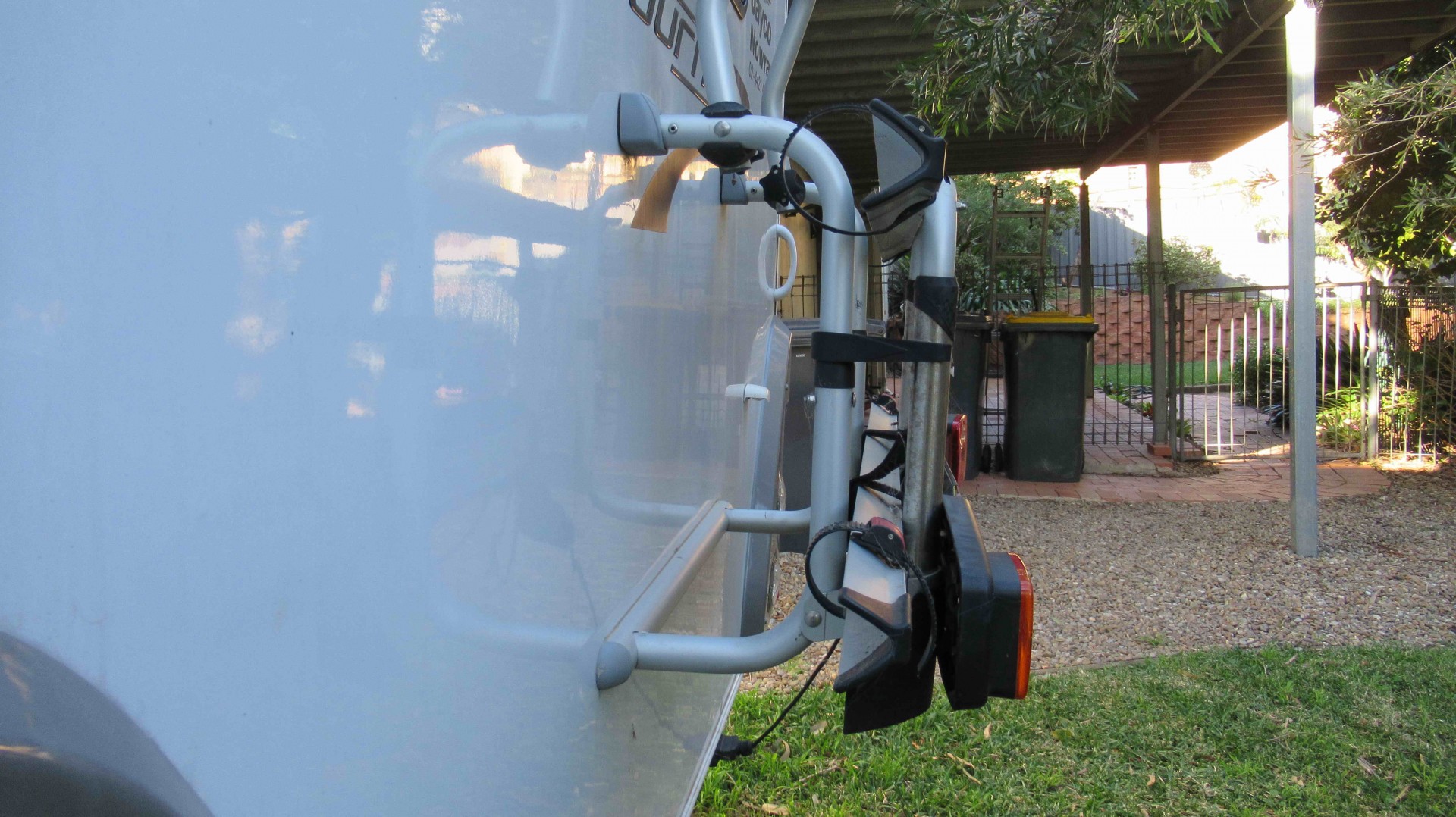
Because any fuel container can rupture ( in rear end accident) and cause/fuel a fire, I would suggest you mount it elsewhere. Depending on the attitude of the Cop or RTA Inspector that has you at the side of the road you may be defected and made to move the vehicle only on the back of a truck.
I wouldn't put it this end either for obvious reasons! Having fuel off the back is another load that you will have to account for on the towball.
I keep my fuel on the roof.
Hi Laurie....the short answer is "No".Cheers
-- Edited by yobarr on Friday 5th of June 2020 06:53:18 PM
20 litres is too heavy on the roof to get on & off regularly, & that's the point, to get it in the tank ASAP. I have four 10L & two 5L in the second spare wheel.
Custom made holders out of anodised aluminium & stainless Allen bolts, tapped & Nyloc nuts.
I think the brains trust are getting it wrong, yobarr thing refers to flammable liquid, diesel is not classified as a flammable liquid.
I think the man is talking about a small, perhaps 5 litre diesel tank for his heater.
You need to ask more questions.
He need needs to tell you more.
Spot on Radar.
Flash point
The flashpoint of a flammable or combustible liquid is the lowest temperature at which the substances will give off sufficient flammable vapours to ignite in air.
Flammable liquids
The Australian Dangerous Goods Code outlines the definition for flammable liquids. This code states:
Flammable liquids are liquids, or mixtures of liquids, or liquids containing solids in solutionor suspension (for example, paints, varnishes, lacquers, etc., but not including substancesotherwise classified on account of their dangerous characteristics) which give off a flammablevapour at temperatures of not more than 60 °C, closed-cup test, or not more than 65.6 °C, open-cup test, normally referred to as the flash point. This class also includes:
Liquids offered for transport at temperatures at or above their flash point; and
Substances that are transported or offered for transport at elevated temperatures in a liquid state and which give off a flammable vapour at a temperature at or below the maximum transport temperature.
Combustible liquids
The Australian Standard that outlines the requirements for the storage and handling of flammable and combustible liquids provides us with a definition of combustible liquids: This standard states:
A combustible liquid is any liquid, other than a flammable liquid, that has a flash point, and has a fire point that is less than its boiling point. There are two different classes of combustible liquids. These include C1 & C2.
Class C1: A combustible liquid that has a closed cup flash point of greater than 60°C and no greater than 93°C.
Class C2: A combustible liquid that has a flash point greater than 93°C.
Therefore, flammable liquids are liquids that have a flash point below 60 °C and combustible liquids are liquids that have a flash point above 60 °C but below its boiling point. We can now use this information to determine whether diesel fuel is flammable or combustible.
Flammability of diesel fuel
Diesel fuel is any kind of liquid fuel that can be used in diesel engines. A diesel engine is an internal combustion engine which uses the heat produced from the compression of air to ignite the fuel that is injected into its cylinders. As there are a number of different kinds of diesel fuel, there is no straightforward answer as to whether they are flammable or combustible. The flash point of each diesel fuel must be checked to determine if its classified as a flammable liquid or combustible liquid. This information can be found by checking the safety data sheet for each diesel fuel. Diesel fuels normally have a flash point between 52 °C and 93 °C. Therefore those diesel fuels that have a flash point below 60 °C are classified as flammable liquids and those that have a flash point above 60°C are classified as combustible liquids.
Hey Possum dear man, have you ever been sitting on the side of the road freezing your tits off and tried to light a fire with no success because the timber is cold and damp, dripped a rag into your fuel tank of diesel and tried to light that rag, well you would of gotten more warmth out of the match.
Back to the man question.
You need more information as to what his intention are.
He could ring Colin up, you know the man, he would give you the answer.
I use diesel to start campfires quite often - tried and true method.
I assume you are referring to Colin Young at CARAVAN COUNCIL OF AUSTRALIA 3 Margaret Street Parkdale VIC 3195 Tel: 0409 865 399 Fax: 03 9587 1828
"Jerry cans with unleaded in them cant be mounted on the front or rear of your vehicle, inside the cab, rear of caravans or campers essentially anywhere that is an impact zone. In the back of a ute is just about one of the only places for them.
Jerry cans with diesel in them, however, may be mounted essentially wherever you like (within reason), as its not classed as a combustible/explosive liquid in the sense that unleaded is"
It is a 10 liter plastic tank with line going to the diesel heater
Laurie
Thank you Laurieoz.
Yes I believe you can fix that 10 litre tank of diesel on the back of your caravan.
Be aware of your weights and measures before you mount the tank.
Approach your state motor vehicle registration body first to be certain.
Laurie, Irregardless of capacity of tank - It should not be mounted at rear of vehicle. Transport of Dangerous Goods Act can be invoked by Police or Dept of Transport Officers - Diesel is either Flammable or Combustible Liquid (see my above post) - you can be required to show proof of Flash Point of what type you have in tank.
If contacting Dept Motor Transport ensure you do it in writing, and IF they say OK keep their written approval (in vehicle) to show any questioning/unbelieving official.
I'm afraid I cannot answer your question with any authority but I thought I'd let you know that my heater's 10L diesel tank is mounted on the rear bumper of my caravan and, so far, death and destruction has not resulted although I appreciate if things go terribly wrong it may explode and kill one or all of the following:
1 - Nuns on a pedestrian crossing
2 - Small children and pregnant women in a playground
3 - Tiny kittens just learning to walk
It is for reasons of safety I keep my home-made 10A to 15A adaptor lead inside the caravan.
I just love it and I do not use a WDH.
I upgraded the suspension to a Higher Loading/Weight capacity on my Avan Cruiseliner and had to have it inspected and new ID plate issued. That was about two years ago.
The inspector checked suspension job, Brakes Jacked up and spinning etc., Chassis, Chains, Hitch, walked around and, inspected, lights on/off, Indicators working, body and panels in good order, Gave the spare wheel a heave ho. Noted my Jerry can Holder (Grey water Container)
Then as he noted my Diesel Heater Fuel Tank, "Is that for a diesel heater" So then we had a short conversation about diesel heaters in small campers. How good they were, where did I fit mine etc. Not even a suggestion about if the tank should be there or not.
It's been on there since 2011 for everyone to see. Fitted in "behind the Spare Wheel" and the Jerry Can holder the others side fitted in behind the spare.
Also carry 2 20lt fuel containers in the jerry can holders which came with the van on the rear bumper, when I know its a long distance between bowsers.
Ray
Thanks Possum,for this well constructed and informative post. My post simply was a screen shot of an internet discussion on this subject,and possibly has about as much credibility as a report from a 4wd site? Who knows? Once again,thanks for providing the facts.IMHO,carrying any fuel on the front or rear bumpers of a car is stupidity in the extreme.Cheers.
Ahhhhh But do you use a generator ?.
-- Edited by landy on Saturday 6th of June 2020 10:26:55 PM
When one needs more fuel!
I don't think so:
https://www.ntc.gov.au/sites/default/files/assets/files/Australian-Code-for-the-Transport-of-Dangerous-Goods-by-Road%26Rail-7.6.pdf
I'll leave it as an exercise for you to work your way through it and discover why it's OK to carry diesel on the rear of a caravan.
Had a generater, never used for camping.
Had my tank on the back of the van for 5 or 6 yrs.