There was a pothole at the base of a hill next to the Salvation Army Hall not far from my office in my home town.
When it rained it took up half of the road and was a few inches deep and for days after the lake still existed.
As a message to council, I was really keen to put a "No Fishing" sign in the thing.
In a nutshell, they simply cannot fill a pothole, because there is no ballast holding the substrate... Once they fill them, you normally get about a week maybe two, before the problem re-presents itself. That's also why you have often grass growing in the middle of the street and when it rains the water has no way of displacing off the road
Other than a couple of segments, I don't believe QLD has ever had or built real roads... They are better described as tarmac tracks. As in, a thin film of tar mixed with some gravel on top of the graded dirt... Proper roads, have a decent amount of ballast (normally around 50 to 70cm to both retain consistency and displace the weight. (think of the train track, where the ballast holds the track in place and distribute the weight of the train over a larger surface). Then on top of that you get you should get another 20 cm of road base (crushdust or similar aggregates) that allows the road to be raised above the side so to allow water dispersion. Then finally you should get the tarmac again another 5-20 cm which now has the chance to support the weight (ballast) and be smooth (crushdust) and should allow them a gap of 10-15 years before having to replace just the top tarmac as it wears out...
That's the simple reason of why you have a constant and countless numbers of potholes and mushroom (that's where the road comes up next to the pothole).. It will never work, and it is a false sense of economy.. Instead of maintain a road every 10-15 years, and in good conditions, they constantly rip the 2mm of tarmac and simply reapply a new coat every few months to keep the cost down and cover several locations on a low budget, that get thinner and thinner every year as more tarmac tracks get built...
But as the population increases, and the weight of the trucks get higher, they have run out of steam, and it is too late now to start to build real roads, as you would have to rip the lot and start again from the bottom with the real ballast not just dirt... It would cost more than if they did build a road following the correct procedure in the first place, 100 years ago...
To give you an idea of how far some country will go, in Switzerland back in the 60', the supervisor in charge after they finish a new road or fixing an old one, would have tested them by using a glass of water placed on the dashboard... If any water comes out at any time, even in a corner, they would have started the job again... I'm sure that today, they no longer use the glass of water test, but that gives you an idea of how far some country will go to produce great results...
I often ask if, when the local government wants has to have vehicle that are roadworthy and keep them roadworthy, why can't they give us roads that are roadworthy of our vehicles... It is costing the public a fortune in vehicle maintenance and the issue will just get worse as traffic and population increases..
The solution: more speed camera and keep lowering the speed limit to compensate for the danger of driving on QLD roads, sorry tarmac tracks.. Then again, it is not just QLD having this problem, but QLD does have the record for the worse tarmac tracks in Australia.. Then of course the old never ending excuse: we don't have enough population to afford to build real roads.. And yet we have enough population to create all those potholes in the first place..
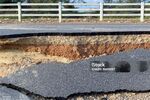
Here is a picture that does show what I'm talking about:
You can clearly see the dirt, then the road base and finally about 5cm of tarmac, but there is no ballast... I'm not talking about how the road broke. I'm just using the picture to show the substrates... And the one in the picture it is actually not bad. I have seen roads where they avoid the road base altogether and just put the tarmac on top of the graded dirt..
I have been on enough historical Roman roads & they were in a pretty sorry state. There were lots of deep ruts in the roads from carts. Also many potholes.
__________________
Procrastination, mankind's greatest labour saving device!
50L custom fuel rack 6x20W 100/20mppt 4x26Ah gel 28L super insulated fridge TPMS 3 ARB compressors heatsink fan cooled 4L tank aftercooler Air/water OCD cleaning 4 stage car acoustic insulation.
I have been on enough historical Roman roads & they were in a pretty sorry state. There were lots of deep ruts in the roads from carts. Also many potholes.
I would like to see how you are holding up, after 2500 years and no maintenance... Plus in those days they used metal rims.. Have a look on google for the Via Emilia... It goes from Milano to Rimini and still today it is used as a main arterial road... But the most interesting fact is that the Romans managed to build a perfectly straight level road even back then...
I take a Roman road build 2500 years ago any day over a new QLD road built today...
-- Edited by Burt65 on Monday 11th of May 2026 08:24:12 AM
I have been on enough historical Roman roads & they were in a pretty sorry state. There were lots of deep ruts in the roads from carts. Also many potholes.
I wonder if some folks wish that they had given more thought to what they posted?
__________________
"When all is said and done, more is said than done"



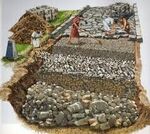
 Plus in those days they used metal rims.. Have a look on google for the Via Emilia... It goes from Milano to Rimini and still today it is used as a main arterial road... But the most interesting fact is that the Romans managed to build a perfectly straight level road even back then...